Booking pages describe destinations. They rarely describe the day — where you are collected from and why it is not your hotel door, how long you actually stand in each village, what the guide does at an archaeological site, when lunch happens, and what the last hour looks like when several thousand people are trying to leave the same village at once.
This guide covers the mechanics. What happens hour by hour on santorini tours, what is included and what is not, what the vehicle is like, and the small operational details that decide whether a day feels spacious or rushed.
For travellers planning the island, santorini tours and santorini tours offer expertly guided experiences across Santorini — from caldera sunsets and volcano walks to private wine tastings and tailor-made sightseeing.
How Do Santorini Tours Begin?
With a pickup at the nearest point a vehicle can reach — which is frequently not your accommodation.
A great deal of the island’s lodging cannot be reached by car at all. Cliffside hotels in Oia, Imerovigli and Firostefani sit several hundred steps below or above the nearest road, so the meeting point becomes a village square, a cable-car exit or a bay on the main road.
A surprising share of poor reviews across santorini tours describe a driver waiting somewhere the guest never found. Confirming the exact pickup point in writing beforehand removes the single most common failure on the day, and it costs one message.
What Time Do Santorini Tours Start?
Between 08:00 and 09:30 depending on the season, and earlier is materially better.
The crowd curve santorini tours work against is steep and predictable: light until ten, heavy from eleven to two, easing until four, then compressing hard into the sunset window. An eight o’clock departure reaches the first village before the cruise tenders finish unloading.
The same route two hours later spends the whole day behind several thousand people. Among all the variables on santorini tours, the start time changes the day most and costs nothing.
What Vehicle Do Santorini Tours Use?
A saloon or minivan on private bookings, an eight to eighteen-seat minibus on shared, and occasionally a fifty-seat coach.
On santorini tours vehicle size decides more than comfort. A minivan reaches pickup points a coach cannot, parks where a coach must drop and circle, and moves through the pinch points faster. A coach group generates its own queue at every stop.
“Comfortable transport” accurately describes both, which is why it is worth asking for the vehicle type and the maximum group size before booking. Across santorini tours it is the most useful question after the departure time.
What Happens At The First Stop?
Usually Oia, forty-five to ninety minutes, walked rather than driven.
On santorini tours the vehicle parks at the edge of the village and the group walks the main lane — around a kilometre end to end — past the blue-domed churches to the castle ruin at the western tip. A guide points out the domes, the cave-house construction and the caldera opposite.
Read more: Santorini Private Tour and Food Experience
Before ten the lanes are quiet enough to walk two abreast. After midday it becomes a shuffle. This is the stop where the departure time pays for itself most obviously, and good santorini tours place Oia first for exactly that reason.
How Long Do Santorini Tours Spend At Each Stop?
Oia 75–90 minutes, a caldera viewpoint 30–45, Akrotiri 60–75, an inland village 40–60, a winery 60.
On santorini tours those allowances plus travel time determine how many stops fit. Fira to Oia takes twenty-five minutes at dawn and fifty or more at four in the afternoon; Fira to Akrotiri about thirty.
Counting the stops and dividing by the hours is the fastest way to judge any listing. Five stops in nine hours is generous; eight in the same window is a vehicle tour with photo breaks.
What Does The Guide Actually Do?
Narrates between stops, walks the villages with the group, and hands over to a site guide at Akrotiri.
For santorini tours Greek law restricts lecturing inside archaeological sites to certified guides. A driver-guide — however knowledgeable — legally cannot narrate inside Akrotiri, so reputable operators arrange a licensed site guide for that stop and continue with the driver elsewhere.
Ask which arrangement applies before booking. It is the single most consequential detail on any archaeology-focused day and it is rarely stated on a listing page for santorini tours.
What Happens At Akrotiri?
An hour indoors on raised walkways above a Bronze Age town, roofed and cool.
On santorini tours Akrotiri is a settlement of multi-storey buildings, paved streets and indoor plumbing, buried under volcanic ash around 1600 BC and preserved by it. No bodies have been found, which suggests the population evacuated after warning tremors.
Elevated walkways run above the excavation, so the walking is level and the roof makes it the coolest stop of a summer day. Unguided it is a set of stone walls; guided it is a town with streets you can follow.
Read more: Santorini Sunset Tour
When Does Lunch Happen?
Between one and two, for about an hour, and it is not included in the price.
Shared santorini tours stop at a taverna the operator works with — usually competent, chosen for parking and capacity rather than cooking. Private ones stop wherever you want, which is where the format difference shows most clearly.
Budget €15–€25 a head. On santorini tours the better kitchens are inland at Pyrgos, Megalochori and Exo Gonia, where rents are lower and the customers are more often local. Ask the driver where they eat; the answer is never the restaurant with the best terrace.
What Is Included In The Price?
Transport, fuel, parking and the driver’s day. Not entries, tastings, lunch, the cable car or tips.
On santorini tours those five exclusions add €30–€60 per person to any full day: Akrotiri entry at about €12, a winery tasting at €15–€25, lunch at €15–€25, the cable car at €6 each way, and a tip of €5–€20.
Rebuild both quotes with them added before comparing two listings, because a €70 tour with everything excluded and a €95 all-in tour are frequently the same number. It is the arithmetic almost nobody performs when choosing between santorini tours.
What Happens At The Winery?
A seated tasting of three to five wines, forty-five minutes to an hour, sometimes with a vineyard walk.
On wine santorini tours the Assyrtiko grows on vines woven into low circular baskets pressed flat against volcanic ash, a technique developed to survive wind and near-total drought. The vines are ungrafted because phylloxera cannot survive the soil.
The vineyard walk is the element most often omitted and the one that makes the stop, because the baskets in the field explain what the tasting room cannot. Late afternoon is the right slot, and it is why anticlockwise santorini tours work so well.
How Do Santorini Tours End?
At a sunset viewpoint, then a drop back at the morning pickup point.
Read more: Popular Destination Santorini Private Tour
Standard santorini tours finish in Oia, which is where the day most often goes wrong. Several thousand people compress onto a walkway two metres wide, and afterwards they all leave along a single road where a taxi is effectively unobtainable.
Better-designed itineraries end at Imerovigli, Skaros or Profitis Ilias — the same sun over the same caldera, with room to stand and a five-minute exit. Ask where the tour watches sunset before booking; it separates operators more sharply than price does.
What Should You Bring?
Closed shoes with grip, two litres of water, sun protection, a wind layer and cash in small notes.
On santorini tours the village lanes are marble polished smooth by decades of foot traffic and considerably steeper than they photograph. The volcano path is loose gravel. Sandals are wrong for both.
Water matters because the island is arid with almost no shade. Cash covers entries, tastings, the cable car and tips, since card acceptance at village stops is inconsistent. Guides on santorini tours repeat all of this and it remains the most ignored advice on the island.
How Much Walking Is There?
Four to six kilometres across a full day, almost all of it on stone, with several hundred steps.
On santorini tours the distances between stops are driven, but every stop is walked. Oia’s main lane is roughly a kilometre. Pyrgos climbs steadily to its castle. Akrotiri is a level hour. Add the Ammoudi steps and the total rises sharply.
None of it is difficult for anyone reasonably mobile, but it accumulates, and visitors routinely underestimate it because the map makes the island look tiny. Santorini tours are not strenuous and they are not sedentary either.
Are There Toilets And Breaks?
At every village stop; not on the minibus and not on the volcano.
On santorini tours Oia, Fira, Firostefani, Imerovigli, Pyrgos and the beaches all have facilities, so a land itinerary passes one roughly every hour. Catamarans have them on board.
Read more: Santorini North Part Tour
Nea Kameni has none, and neither does the seven-kilometre stretch of caldera path between Imerovigli and Oia. Those are the two places on santorini tours where planning ahead genuinely matters.
What Happens If Someone Is Late?
On a shared tour everyone waits; on a private one there is nobody to wait for.
On shared santorini tours fifteen people returning to a vehicle at four stops means four departures set by the slowest returner, and across a nine-hour day that is routinely thirty to forty-five minutes.
Those minutes come out of stops later in the itinerary, which is why shared santorini tours often feel rushed at the end even when they started comfortably. Nothing has gone wrong; the schedule has absorbed the delay and passed it downstream.
What Happens In Bad Weather?
Land itineraries run regardless; boat trips cancel and reschedule.
For santorini tours rain between June and September is close to nonexistent. What interrupts plans is the meltemi, a hard northerly that stops catamaran sailings at short notice between mid-July and early September, and makes exposed clifftop viewpoints tiring rather than dangerous.
A private driver will swap an exposed stop for Akrotiri, which is roofed, or extend the winery. Shared santorini tours run the published route because changing it would need agreement from a full vehicle.
Do Santorini Tours Wait For Cruise Tenders?
Yes, if the operator has your ship name and all-aboard time.
For cruise santorini tours the tenders run late routinely — weather, sequencing, a slow first wave. Local companies deal with it constantly, and the correct response is to shorten stops or drop the third one rather than shave the return buffer.
Give the details at booking rather than on the morning, and keep the operator’s number written down. Roaming inside the caldera is patchy and ship wifi is unreliable.
Read more: Santorini Private Custom Tour
What Does A Good Day Feel Like?
Unhurried, with fewer stops than the listing you nearly booked.
The santorini tours people describe warmly afterwards have five stops rather than eight, start before nine, and end somewhere with room to stand. Nobody comes home wishing they had squeezed in another viewpoint.
Operators who push back on customers asking for more stops are giving good advice rather than cutting corners, and the santorini tours that look thinnest on paper are frequently the best days.
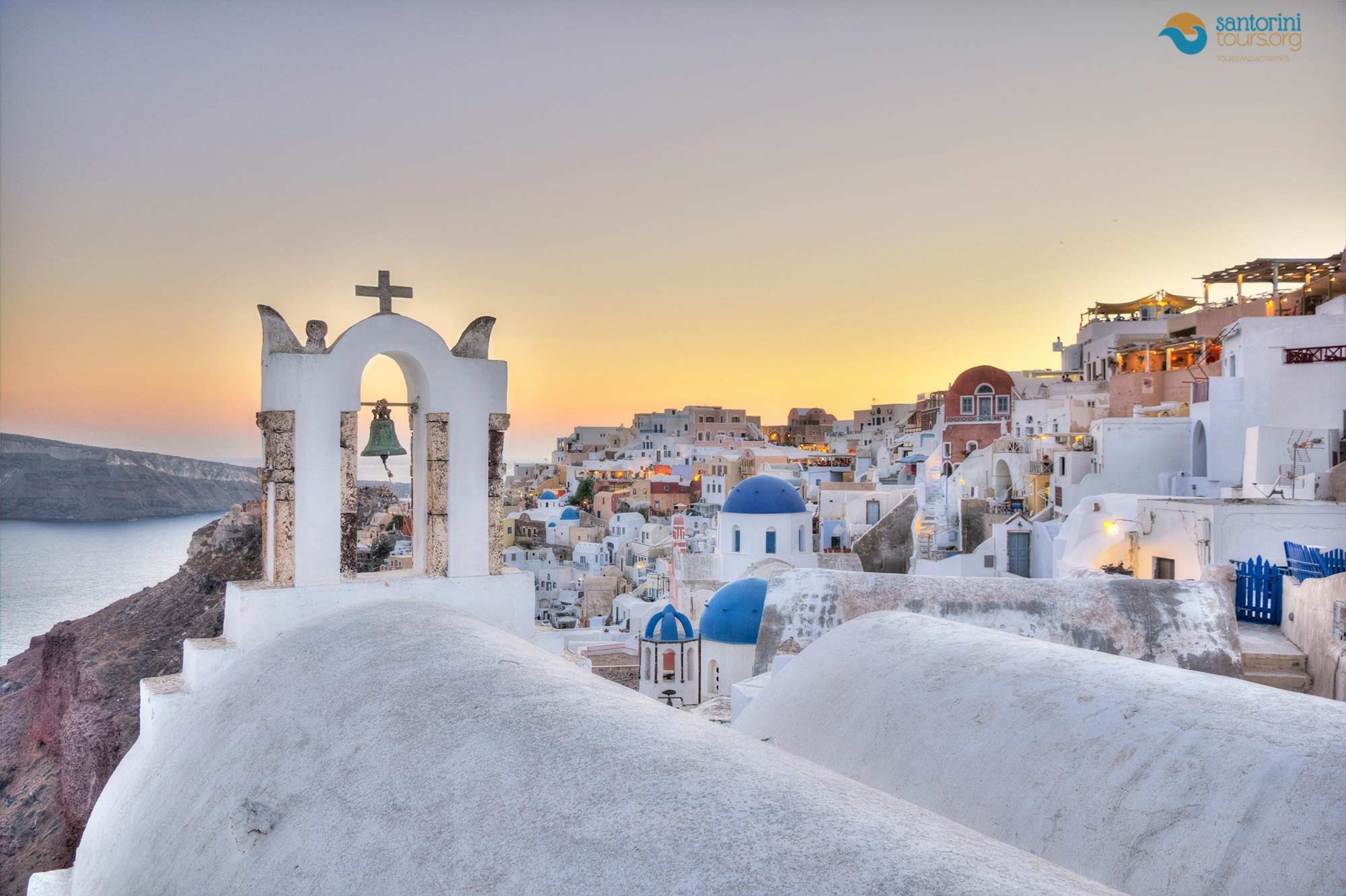
Santorini from the air: the caldera, the villages and the cliffs.
What Do People Complain About Most?
Feeling rushed, the Oia sunset, and the wrong shoes.
On santorini tours rushing is usually structural: too many stops, a late start, and accumulated boarding delay. The Oia sunset is a venue problem rather than an operator one. And smooth-soled sandals on polished marble is how holidays end early.
All three are avoidable at the booking stage, which is why the five questions — how many stops, how long at each, which direction, what is excluded, where exactly is the pickup — matter more than any review of santorini tours.
What Happens On A Boat Day Instead?
Departure mid-afternoon, swimming stops, the volcano, a meal cooked on board, sunset from the water.
Boat santorini tours leave from Vlychada marina in the south or the old port below Fira. The first hour runs along the southern coast past the Red and White beaches, with an anchored swim in water that is deep, clear and colder than it looks.
The middle covers the volcanic islets: a pass by Aspronisi, the geothermal seep off Palea Kameni, and on longer itineraries a landing on Nea Kameni for the thirty-minute crater climb. Lunch is cooked aboard and is generally better than the price suggests.
Read more: Santorini Sunset Tour
The return runs north along the caldera wall as the light drops, which is when the banded cliffs are legible, finishing beneath Oia at sunset. Among santorini tours it is the itinerary covering the most ground no land route reaches.
How Do Santorini Tours Handle Mobility Needs?
With a private vehicle and a route built from stops reachable directly from the car.
On accessible santorini tours Oia's main walkway is manageable while its side lanes are stepped. Akrotiri is largely level and roofed, which makes it one of the most accessible major sites in the Cyclades. The cable car is step-free but the old port at the bottom is not.
Profitis Ilias, the Pyrgos approach and Firostefani’s paved rim all work without significant walking, and a genuinely comfortable day is entirely possible. It has to be designed in advance rather than improvised on the morning.
Be concrete when booking: stair counts, walking distance and time spent standing matter far more than a general description. Wheelchair-capable vehicles exist but are limited, so lead time matters more here than for any other request.
What Do Santorini Tours Not Include?
Anything you consume, anything you enter, and anything you tip.
The ticket buys transport, the driver’s day and the guiding. Archaeological entry, museum tickets, winery tastings, lunch, drinks, the cable car and gratuities all sit outside it, and together they add €30–€60 per person to a full day.
Also excluded: restaurant reservations, photographers, and anything on the water if you have booked a land itinerary. Operators will arrange most of them on request and usually at local rather than tourist prices, but they are extras rather than inclusions.
The one thing worth confirming specifically is whether the Akrotiri entry and the winery tasting are bundled, because those two account for most of the variance between listings that otherwise look identical.
Frequently Asked Questions About The Day
Is Hotel Pickup Included?
To the nearest vehicle access, yes. Many cliffside hotels cannot be reached at all, so the meeting point moves.
Read more: Popular Destination Santorini Private Tour
How Big Is A Small Group?
Eight to twenty-five, depending on the operator. Ask for the number; it is the vaguest phrase in the market.
Can You Leave The Tour Early?
On private santorini tours yes; on shared ones only at a village with bus access.
Is Wifi Available On Board?
Rarely on minibuses, sometimes on catamarans. Mobile coverage is good across most of the island.
What Language Is The Commentary?
English by default, with other languages on request for private bookings.
How Much Should You Tip?
€5–€10 per person for a good half-day, €10–€20 for an excellent full day. Cash, given directly, never obligatory.
How Do Santorini Tours Differ From What The Listing Says?
Mostly in the time actually spent standing somewhere, which no listing states.
On santorini tours a nine-hour day with six stops sounds generous. Subtract two and a half hours of driving, forty minutes of accumulated boarding delay on a shared vehicle and an hour for lunch, and the time genuinely spent at the places you came for is closer to four hours.
That figure is the honest measure of a day out here, and it is why stop count divided by hours is a better comparison than price. Five stops in nine hours delivers around five and a half useful hours; eight stops delivers the same total split into fragments.
Listings for santorini tours emphasise coverage because coverage sells. The days people remember are the ones with fewer stops and longer at each, which is the opposite of what the marketing rewards.
What Should You Confirm Before The Day?
Pickup point, start time, stop list, exclusions, and where sunset is watched.
Read more: Santorini North Part Tour
Those five answers characterise a day of santorini tours more accurately than any description. The pickup point prevents the most common failure. The start time predicts the crowds. The stop list divided by the hours gives the pace. The exclusions rebuild the real price. And the sunset venue decides how the day ends.
A good operator answers all five in a sentence each, in writing, before you pay. Evasion on any of them is more informative than a page of reviews, because vagueness on those specifics is rarely accidental.
Add any constraint you have at the same time — a flight, a sailing deadline, a mobility need, small children, a dietary restriction at the winery. Operators of santorini tours can accommodate nearly all of it with notice and almost none of it on the morning.
What Happens Between The Stops?
Twenty to fifty minutes of driving, with commentary on the better operators and silence on the rest.
The driving is a substantial share of any day here — roughly two and a half hours across a nine-hour itinerary — and what happens during it distinguishes a good day from an average one. A guide who uses the transfers to explain the geology, the wine, the eruption and the villages turns dead time into the connective tissue of the day.
The route itself is worth looking at. The road from Fira south crosses the island’s gentler eastern slope through farmland and vineyards, which is the working Santorini most visitors never register. The northern run to Oia hugs the rim with the caldera opening out on the left.
On shared santorini tours the commentary is necessarily general, pitched to serve sixteen people with different interests. On a private day it follows whatever the group asks about, and that continuity is what most people remember afterwards.
How Do Santorini Tours Handle Photographs?
By stopping where the light is, if you ask — and by following the map if you do not.
The blue domes on Oia’s northern edge face north-west, so they work late in the day and read flat at noon. The Three Bells of Fira below the Firostefani path needs morning light behind the camera. Vlychada’s carved cliffs want overcast or late light.
Hitting those in the right order means ordering the day around the sun rather than the driving distances, which no fixed schedule can do. Photographers should say so explicitly at booking, because it changes the route substantially.
Read more: Santorini Private Custom Tour
What a private day buys here is waiting time — the licence to stand somewhere for twenty-five minutes while a cloud moves. That is the whole product, and it is unavailable on any shared itinerary at any price.
What Is The Last Hour Like?
Either a viewpoint with room to stand, or the worst logistical moment of the trip.
After the sun goes down in Oia, several thousand people leave a village served by one road. Taxis are unobtainable, the buses fill within minutes, and the walk out is long and dark. Visitors on organised santorini tours have a vehicle waiting at an agreed point; independent visitors do not.
Ending at Imerovigli, Skaros or Profitis Ilias avoids all of it. The sun sets over the same caldera, there is space to set up a camera, and the vehicle leaves in five minutes.
Worth staying twenty-five minutes past sunset if the operator allows: blue hour is when the villages switch their lights on against a sky that still holds colour, and it is when the photographs everyone actually wants appear.
What Does A Half-Day Look Like Instead?
Four to five hours, three stops, and the same drive time to the first one.
A morning half day typically covers Oia, one caldera viewpoint and either a village or a beach, finishing around one o’clock. An afternoon version runs from about three and ends at a sunset viewpoint.
What it does not do is halve the price. A half day is generally sixty to seventy percent of the full-day rate, because the vehicle and the driver are committed either way and the drive to the first stop is incurred regardless.
The trade is a better-paced holiday rather than a cheaper one. Two half-day santorini tours on separate days, each followed by a free afternoon, frequently beat one nine-hour marathon — and with children it is not close.
How Do Santorini Tours Deal With Cruise Days?
By building a ninety-minute buffer and cutting the stop count to three.
Read more: Santorini Sightseeing Tour
The constraint at this port is not the roads. Ships anchor in the caldera and tender passengers to the old port at the foot of a 300-metre cliff, from which the cable car carries around 1,200 people an hour against vessels carrying three thousand.
That bottleneck can absorb an hour in each direction on a multi-ship day, which reduces an eight-hour call to five or six usable hours. Shore-focused santorini tours plan Oia early, one viewpoint and either Akrotiri or a winery, and return well before all-aboard.
Any itinerary promising the full island circuit on a port day has not done that arithmetic, and it is the clearest warning sign when comparing cruise listings.
What Do Operators Wish Customers Would Ask?
Which direction the route runs, and what they would cut.
Drivers who work this island every day know that Imerovigli clears at six while Oia fills, that a particular winery terrace faces west, and that a five-stop day at eight beats a seven-stop day at ten. None of it is on a booking page and all of it is freely given if asked.
The second question is more useful still. Asked what they would remove from a proposed itinerary, most operators of santorini tours will name a stop immediately — usually a second caldera viewpoint that duplicates the first.
What they cannot work with is a fixed list copied from another listing. State the interests, the constraints and the pace you want, and let the route be built from that.
The Short Version
You are collected from a square rather than your door, at eight if the operator is any good. Oia first while it is empty, a viewpoint, Akrotiri through the midday heat, lunch inland, a winery in the late afternoon, sunset somewhere other than Oia, and a drop back where you started.
Five stops, nine hours, €30–€60 of extras on top of the ticket, and four to six kilometres on your feet. That is what santorini tours actually consist of, and the itineraries promising considerably more are the ones to look at twice.
What Is The One Booking Decision That Matters Most?
The departure time — earlier beats everything else you could pay for.
The island’s crowd curve is steep and predictable: light until ten, heavy from eleven to two, easing until four, then compressing hard into the sunset window. Almost every published itinerary departs between nine and ten, which puts every operator in the same village at the same hour.
An eight o’clock start reaches the first village before the cruise tenders finish unloading, takes the roofed archaeological site through the midday heat, and finishes somewhere that empties in five minutes. The same route two hours later spends the whole day behind several thousand people.
It costs nothing. Among all the variables in santorini tours — private or shared, five stops or seven, this operator or that one — the start time is the one that changes the day most and the one most travellers decline, because an early alarm on holiday feels wrong.
Do Santorini Tours Explain The Island’s Name Confusion?
Rarely, and it confuses arriving visitors more than it should.
Thera is the ancient Greek name, still used for the archaeological designations — Ancient Thera on the ridge, the Museum of Prehistoric Thera in Fira. Thira is the modern Greek form and the official name of the municipality, which is why bus timetables and road signage use it.
Santorini is the Venetian name: a contraction of Santa Irini, after a church the Venetians used as a navigational landmark when the island belonged to the Duchy of Naxos. It stuck with foreigners and never displaced Thira locally.
The practical consequence is that a bus marked Thira is going to Fira, the capital, and that Ancient Thera has nothing to do with the modern town. Guides on santorini tours untangle it in the first ten minutes; visitors travelling independently frequently work it out by the third day.
Can You See The Caldera Without A Boat?
You can look at it from the rim, but you cannot see it — the scale only registers from inside.
Every viewpoint on the island shows the same thing: a curve of cliff, deep blue water, and two black islets in the middle. It is spectacular and it is oddly hard to read, because there is no reference for the distances involved.
The crossing changes that in about ten minutes. The rim rises to 300 metres above you, Oia becomes a thin white line along the top, and the two islets that looked small from Fira turn out to be substantial volcanic islands with a thirty-minute climb on them.
The cheapest approximation on land is the cable car down to the old port, which costs €6 and puts you at the foot of the cliff looking up. It is genuinely worth doing for that alone, and it is the one thing land-based santorini tours can offer that comes close.
What Do People Wish They Had Known?
That the boat day is the one to book first, and that the hot springs stain swimwear.
The first is a scheduling point with real consequences: wind cancels sailings between July and September, and a catamaran booked for the last afternoon of a stay has nowhere to move to. Booking it on day one costs nothing and removes the risk entirely.
The second is trivial and universally ignored. The iron oxide in the geothermal seep is permanent on light fabric, and every sailing produces a few people discovering it afterwards.
How Do You Compare Two Santorini Tours On Price?
Rebuild both quotes with the five standard exclusions added, then divide by the hours you will actually spend standing somewhere.
Archaeological entry, winery tastings, lunch, the cable car and tips add €30–€60 per person to any full day, and listings differ wildly in how many they bundle. A €70 tour with five exclusions and a €95 all-in tour are frequently the same number, and the ranking inverts more often than not.
The second calculation is subtler. A nine-hour day with six stops sounds generous until two and a half hours of driving, forty minutes of boarding delay and an hour for lunch are subtracted — leaving perhaps four hours actually at the places you came for.
Measured that way, a shared seat at €75 and a private vehicle at €400 split between five people work out close to level per useful hour, and the private version includes door-to-door collection. Very few people run either sum, which is exactly why the pricing spread across santorini tours survives.
What Should A First-Time Budget Visitor Book?
One shared land day, one boat, and nothing else.
Those two cover the caldera villages, the archaeology, the interior, the volcano and the crater from inside — which is the whole island in two outings for around €200 per person. Everything remaining is reachable by bus or on foot for a few euros a day.
The temptation is to add a third booked day, and it is consistently the one people report as wasted. The road network forces every land route through the same villages, so a second land tour overlaps the first by more than half.
Two santorini tours and several free days is both the cheapest sensible plan and, by most accounts, the better holiday.
Which Beach Do Santorini Tours Choose In Peak Season?
Perissa and Vlychada, because Kamari fills first and its parking is the tightest on the coast.
In July and August the east-coast beaches fill from about noon, and Kamari’s promenade car park is full well before that. Perissa is longer and absorbs more people, and Perivolos at its southern end rarely reaches capacity at all.
Vlychada is the quieter alternative in any month, partly because it has less infrastructure and partly because most visitors have never heard of it. On a hot August afternoon it is consistently the most comfortable beach stop available.
What Do Santorini Tours Cost For A Family Of Four?
Roughly €400–€550 for a private land day including entries and lunch, or €250–€350 for four shared seats before extras.
The private vehicle is priced per group at €250–€600, so two adults and two children pay the same as two adults alone. Add archaeological entry at about €12 for adults with reduced or free child rates, lunch at €50–€70 for four, and a tip.
Shared seats run €45–€90 per adult with child discounts that are often substantial, which narrows the gap considerably for families with young children. At two adults and two under-tens, shared is usually still cheaper; at four teenagers it is not.
The catamaran is €90–€180 per person with reduced child rates, and it is the day most families rate highest, so it is worth protecting in the budget ahead of a second land itinerary.
Are There Quiet Places To Take Children?
Pyrgos, Emporio and the north-east coast — all of them empty in any month.
The caldera rim is where the crowds are. Fifteen minutes inland the island empties out completely, and the inland villages are considerably easier with children: fewer people, more shade, and lanes where nobody is trying to get past.
Pyrgos has a castle at the top of a manageable climb, which sells itself to most children. Emporio’s medieval kasteli is a covered maze that works as an actual maze. Vourvoulos and Baxedes on the north-east coast are where island families take their own children to swim.
None of these appear on standard itineraries, so they need requesting — but they cost nothing extra and they turn a difficult afternoon into an easy one.
Read More
Discover more from Online Expo:
- Αποφράξεις Αθήνα: Ο Οδηγός Του Ιδιοκτήτη
- Μεταφράσεις Θεσσαλονίκη: Υπηρεσίες Διερμηνείας
- Πολιτική Απορρήτου
- Αποφράξεις Πειραιάς
Contact
Santorinitours.org
Travel Agency In Greece
Karterados 847 00
6936914687